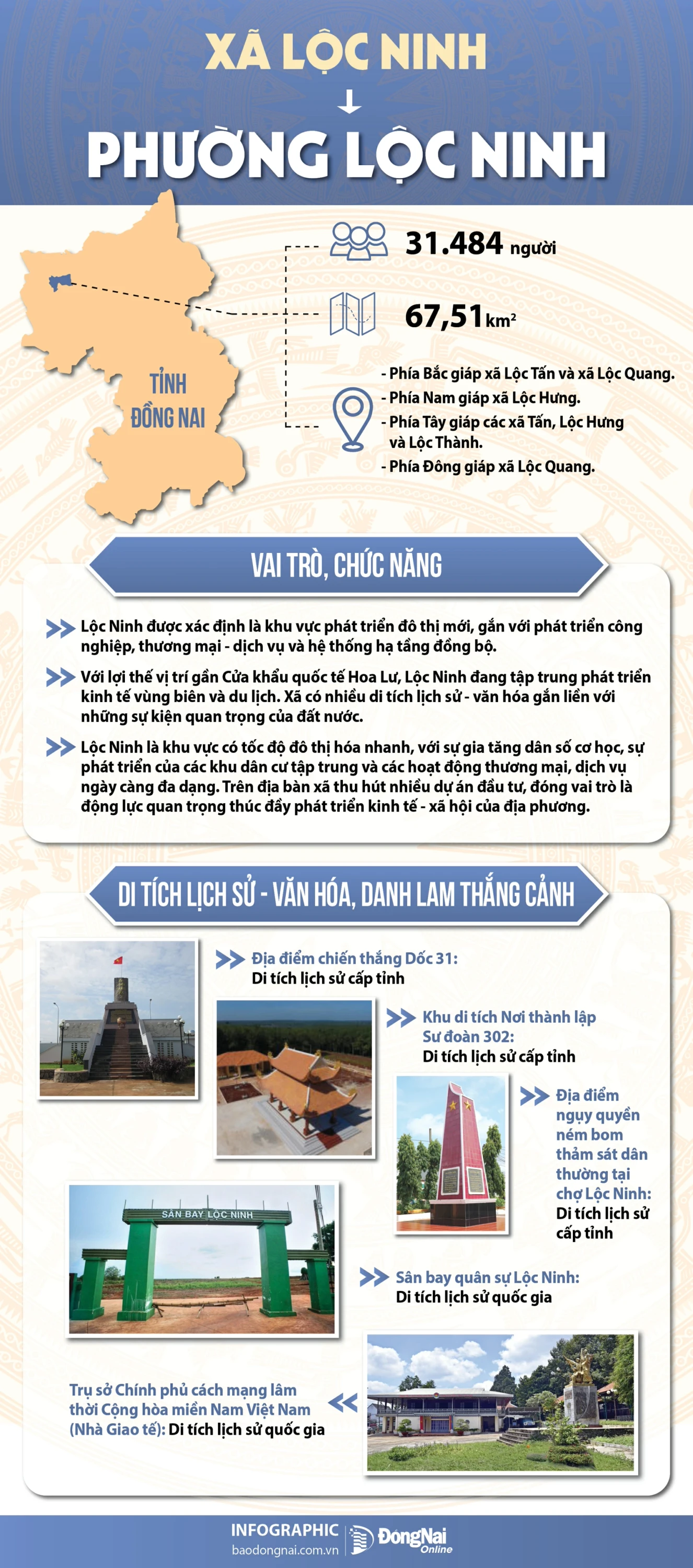
Established on the existing basis of Loc Ninh Commune, Loc Ninh Ward enters a new stage of development as a border urban centre of Dong Nai City. With a population of more than 31,000, a natural area of 67.51 km², an economic structure shifting decisively towards industry–construction and trade–services, and the advantage of sitting on National Highway 13 leading to the Hoa Lu International Border Gate, Loc Ninh is assembling the conditions to become a new growth pole in the northern part of the city.

On 14 April 2026, the Standing Committee of the National Assembly issued Resolution No. 237/NQ-UBTVQH16 establishing 10 wards under Dong Nai City, Loc Ninh among them. The ward was established while keeping intact the natural area of 67.51 km² and the population of 31,484 of the former Loc Ninh Commune. The resolution was formally announced locally on 30 April 2026.
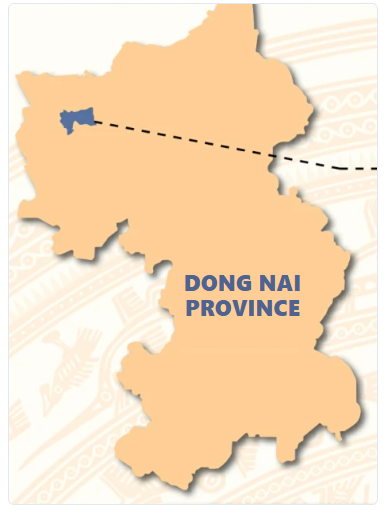
Earlier, on 1 July 2025, Loc Ninh Commune had itself been formed by merging Loc Ninh township with the two communes of Loc Thai and Loc Thuan, then part of Loc Ninh District, Binh Phuoc Province. In under two years the locality has therefore completed two major transitions: the consolidation of administrative units and the upgrade to urban status.

Data behind Figure 3 – the six ward-establishment criteria
| Population size | 31,484 people | ≥ 21,000 people |
| Natural area | 67.51 km² | ≥ 5.5 km² |
| Urban population share | 50.09% | ≥ 50% |
| Budget revenue vs. expenditure | 103.5% | ≥ 100% |
| Share of industry–construction and services | 70.14% | ≥ 70% |
| Non-agricultural labour share | 72% | ≥ 70% |
Loc Ninh Ward lies in the northern part of Dong Nai City, about 100 km from the city centre and about 15 km from the Hoa Lu International Border Gate. It borders Loc Tan and Loc Quang communes to the north, Loc Hung commune to the south, Loc Tan, Loc Hung and Loc Thanh communes to the west, and Loc Quang commune to the east. National Highway 13 runs through the centre of the ward and serves as the “backbone” linking the Hoa Lu International Border Gate with Ho Chi Minh City and the Mekong Delta provinces — a strategic advantage for trade, border commerce and logistics.
In terms of residential organisation, as of June 2026 the ward covered 6,751.05 ha with a population of 31,472 across 29 residential quarters. Under the policy of streamlining the administrative apparatus, the ward has prepared a plan to consolidate these into 10 residential quarters (a reduction of 19), covering 7,676 households; every quarter formed under the plan meets the required minimum of 550 households. Population density is approximately 266 people per km².
The local economy is shifting in the intended direction, with a rising share of non-agricultural activity. Combined output of industry, construction and services reached over 3,000 billion VND in 2025; in the first quarter of 2026 alone it reached approximately 1,400 billion VND, accounting for 70.14% of total output value in the ward. Non-agricultural labour accounts for 72% of the workforce, and the urban population represents 50.09% of the total.
On public finance, local budget revenue stands at 103.5% of local budget expenditure — meaning the ward already balances its own books, exceeding the requirement for ward status.
Per-capita income has risen steadily: 85.15 million VND (2023) – 89.66 million VND (2024) – 93.12 million VND (2025), above the provincial average for the same period (86 million VND per person per year).

Data behind Figure 4 – per-capita income (million VND per person per year)
| 2023 | 85.15 | 86 |
| 2024 | 89.66 | 86 |
| 2025 | 93.12 | 86 |
In the wider context, Dong Nai City recorded GRDP growth of 9.76% in the first quarter of 2026, with an economy of roughly 169.2 trillion VND, of which industry–construction accounted for 54.8% and services 27.36% — leaving considerable room for satellite urban areas such as Loc Ninh.
Despite rapid urbanisation, agriculture remains a foundation: agricultural production land covers approximately 5,600.08 ha, or 82.95% of the natural area. The terrain is relatively flat, and red basalt soil — well suited to long-term industrial crops — accounts for a significant share.

Data behind Figure 5 – land-use and output structure
| Land-use structure | 82.95% | 17.05% |
| Structure of output value (Q1 2026) | 29.86% | 70.14% |
Key products include rubber, cashew, pepper and coffee, alongside large-scale durian farms. Loc Ninh Rubber One-Member Co., Ltd. operates latex extraction and processing locally, and cashew processing is a traditional strength of the area. The ward is planning approximately 1,500 ha for high-technology agriculture, intended both to raise economic value and to preserve an ecological belt around the urban area.
The ward has zoned the Loc Thai industrial cluster of approximately 70 ha, expected to become a new engine of growth, attracting labour and accelerating economic restructuring.
In trade and services, Loc Ninh is designated to develop into a modern border trade and service centre for Dong Nai City, comprising a concentrated commercial centre combined with restaurants, hotels and entertainment facilities; border trade infrastructure; the Hoa Lu inland container depot; and warehousing linked to the industrial parks, clusters and wholesale markets in the area.
In parallel, the system of historical and cultural relics is regarded as a “soft asset” for heritage tourism. It includes two national-level relics — Loc Ninh Military Airfield and the Headquarters of the Provisional Revolutionary Government of the Republic of South Vietnam (the “Reception House”) — together with provincial-level relics: the Doc 31 Victory Site, the site where Division 302 was founded, and the site of the bombing massacre of civilians at Loc Ninh Market.
Human resources are a standout advantage: the working-age population accounts for more than 60% of residents, roughly 18,500–18,700 people, and over 81% of the workforce has received formal training.
Sustainable poverty reduction. Under the multidimensional poverty standard, the ward has no poor households and only 14 near-poor households (as of March 2026).
In education, the ward hosts two upper-secondary schools along with its affiliated educational institutions and one Centre for Vocational Education and Continuing Education, serving more than 6,000 students. In healthcare, there is one main health station and one health station point; health insurance coverage reaches 100%.
Centralised water supply is provided by the Rung Cam Lake Water Plant with a capacity of approximately 2,000 m³ per day and night, serving the central area and the corridor along National Highway 13; 100% of households use clean or hygienic water. Major irrigation works include the Ton Le Cham Dam and the Bu Nau, Rung Cam and Loc Quang lakes.
All residential quarters have a community cultural house, a smart public-address system and national grid electricity, and inter-quarter roads have largely been hardened. The “All people unite to build a cultural way of life” movement has produced solid results, with 29 of 29 quarters recognised as cultural quarters and roughly 98.5% of families holding the “cultural family” title.
Under the planning orientation to 2050, the entire natural area of Loc Ninh is designated as urban development space, comprising an administrative centre, urban residential zones, industrial zones, trade and service zones, and technical infrastructure and public works.
In the period ahead, the ward will concentrate on:

Today
Total