Loc Ninh Ward was established on the existing basis of Loc Ninh Commune, under the policy of the central government and Dong Nai Province on the rearrangement of administrative units. With its strategic location, rapid pace of urbanisation and considerable potential in industry, trade and services, and urban infrastructure, Loc Ninh is steadily affirming its role as a dynamic new urban centre in the northern area of Dong Nai City.
In recent years, the local Party organisation, authorities and people have promoted a spirit of solidarity and innovation, concentrating on infrastructure investment, improving people's quality of life, accelerating administrative reform and digital transformation, and building a civilised, modern urban area. This is an important foundation for Loc Ninh Ward to continue developing rapidly and sustainably in the new period.
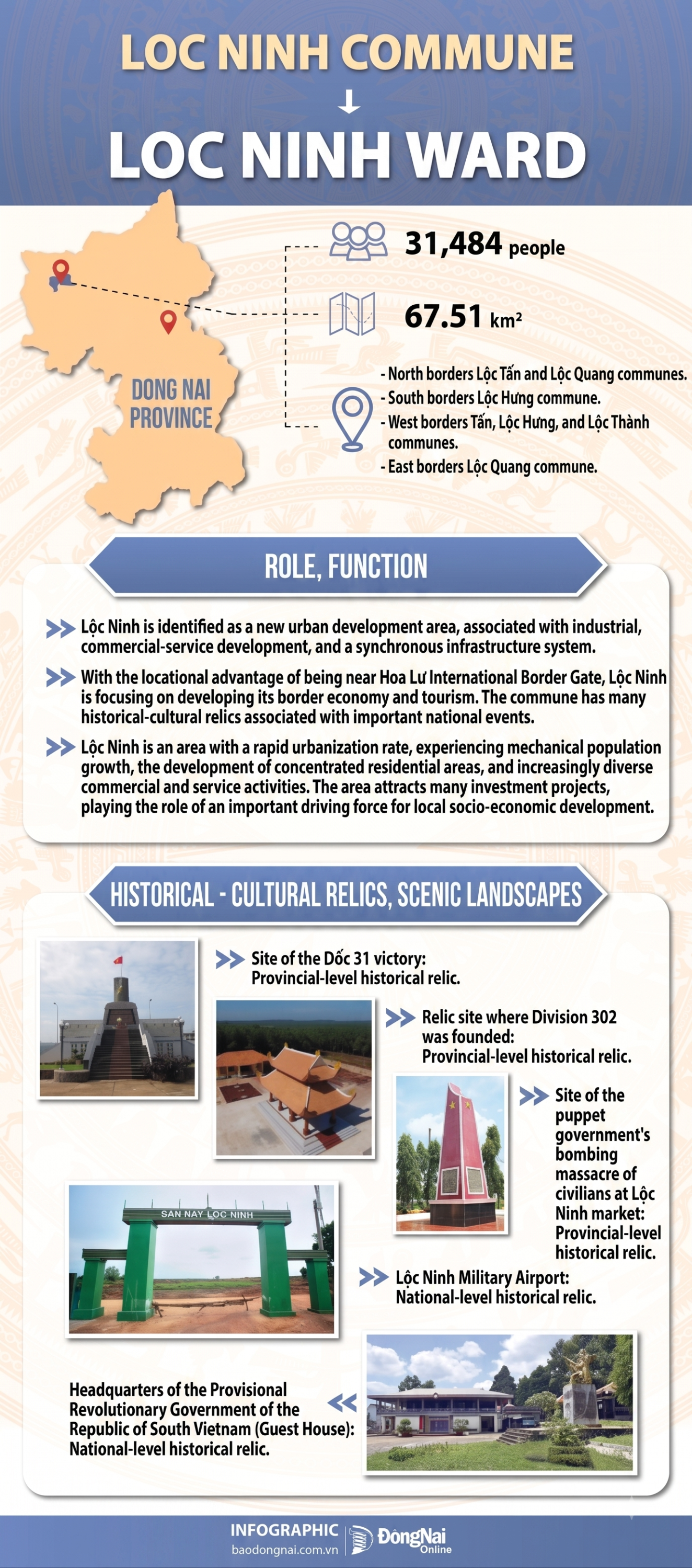
Loc Ninh Ward lies in the northern area of Dong Nai City, about 100 km from the city centre and about 15 km from the Hoa Lu International Border Gate. It holds an important position for trade connectivity, industrial development, trade and services, and regional linkage.
National Highway 13 runs through the centre of the ward, serving as the arterial transport axis linking Loc Ninh with the urban areas, industrial parks and border-gate economic zones of the region. With this advantageous location, Loc Ninh is gradually becoming a driving urban centre and a hub of industrial, commercial and service development in the northern part of Dong Nai City.
In addition, Loc Ninh acts as an intermediate area connecting the northern industrial urban centres with the Hoa Lu Border Gate Economic Zone, contributing to the formation of a continuous, synchronised and sustainable urban development axis for the whole region.
Loc Ninh Ward borders:
Bordering many localities and enjoying a convenient transport network, Loc Ninh has favourable conditions to expand its urban space, develop a multi-sector economy and strengthen economic and cultural exchange with neighbouring areas.
The terrain of Loc Ninh Ward is relatively flat, favourable for urban, industrial, commercial and agricultural development. A variety of soil types are distributed across the area, including alluvial soil, grey soil, red-yellow soil, black soil and basalt soil.
Among these, red basalt soil accounts for a significant proportion and is highly suitable for long-term industrial crops such as rubber, coffee, pepper and cashew, bringing high economic value to local residents.
Stable terrain together with a large land reserve provides favourable conditions for synchronised urban development planning in the future.
Loc Ninh Ward lies within the tropical monsoon climate zone characteristic of the South-East region, with relatively stable temperatures year-round, favourable for daily life, production and socio-economic development.
The climate is divided into two distinct seasons:
Rainfall and humidity are well suited to agricultural development, especially long-term industrial crops. The mild climate, little affected by major natural disasters, also creates favourable conditions for developing a green urban area, ecological landscapes and a better living environment for residents.
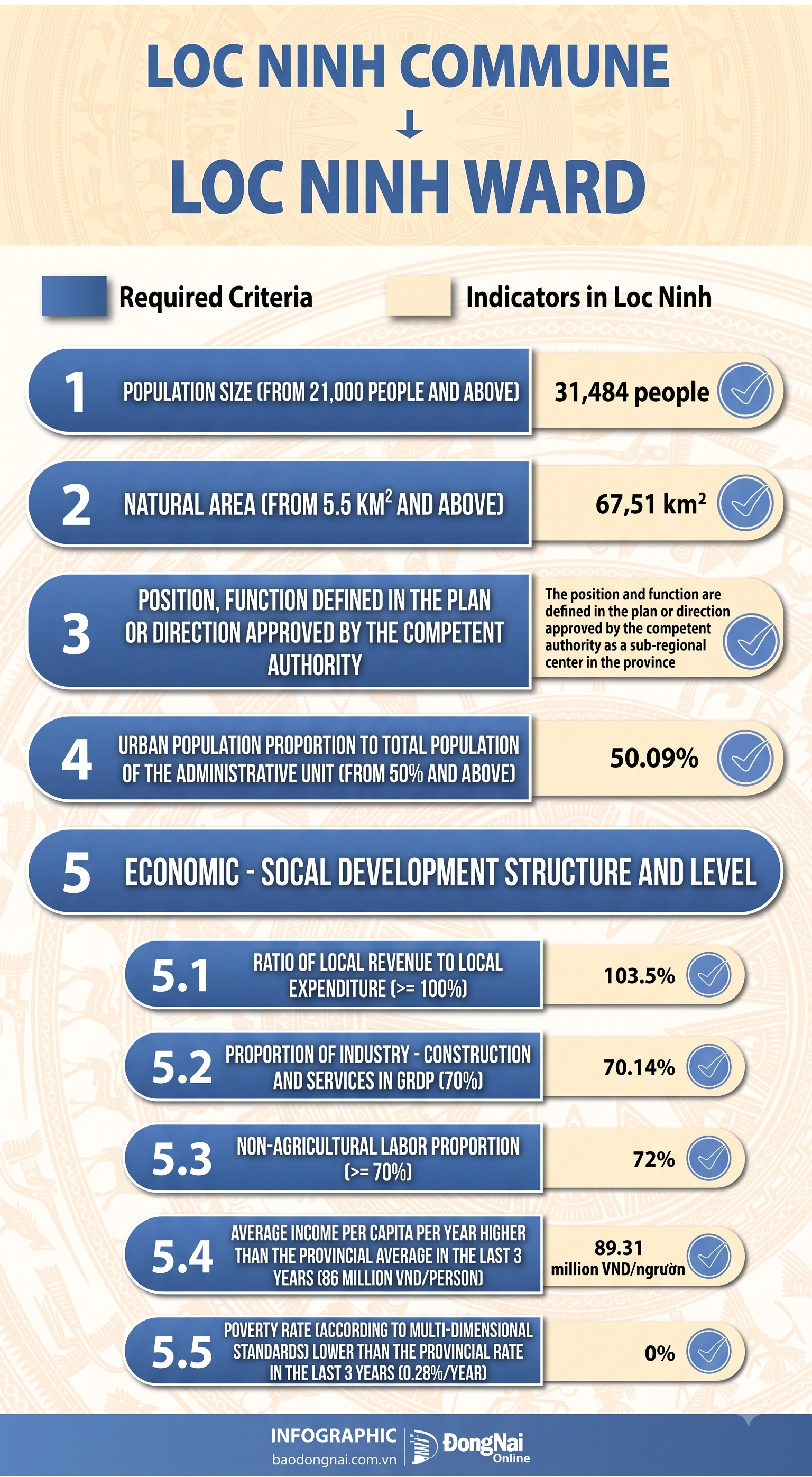
Loc Ninh Ward has a total natural area of about 6,751.05 ha (equivalent to about 67.51 km²).
The current land-use structure clearly reflects a locality in transition from rural to urban:
Under the planning orientation to 2050, the entire natural area of Loc Ninh is designated as urban development space, with functional zones comprising:
This is an important foundation for Loc Ninh to develop into a modern, synchronised urban area in the coming time.
Water sources for domestic use and production in the area are fairly abundant, including reservoirs, irrigation works and groundwater.
Some important irrigation works include:
At present, the Rung Cam Lake Water Plant has a capacity of about 2,000 m³/day and night, supplying domestic water to residents in the central area and along National Highway 13.
The proportion of households using clean or hygienic water reaches 100%. The centralised water supply system continues to be invested in and expanded to meet future urban development needs.
Although Loc Ninh is not an area with a large forest area, it still has zones of greenery, water surfaces and ecological landscapes that play an important role in environmental balance and green urban development.
In addition, the area under long-term industrial crops such as rubber, cashew, pepper and coffee contributes to an ecological belt and a landscape characteristic of the locality.
In its urban development orientation, the locality consistently emphasises linking economic development with environmental protection, increasing green space and using natural resources efficiently and sustainably.
Loc Ninh Ward currently has 29 residential quarters distributed across the whole area.
Residential areas are mainly concentrated in:
All residential quarters (100%) have a community cultural house, a smart public-address system and national grid electricity. Inter-quarter roads have basically been hardened, facilitating trade and daily life for the people.
The movement to build a cultural way of life has been implemented widely:
The material and spiritual life of residents is steadily improving; social infrastructure such as schools, healthcare, culture and sports is gradually being invested in synchronously.
The local economy continues to develop towards a rising share of industry–construction and trade–services. Production and business activities are increasingly developed, contributing to job creation, higher incomes and accelerated urbanisation in the area.
With its advantageous trading position, Loc Ninh is becoming an area with strong potential to attract investment in industry, trade and services.
| Population size | 31,484 people |
| Population density | about 266 people/km² |
| Working-age labour force | over 18,700 people |
The area currently has:
Health insurance coverage reaches 100%; education and public healthcare receive comprehensive attention and investment.
Loc Ninh is a land rich in revolutionary tradition, with many important historical relics:
These are precious cultural resources for developing historical and cultural tourism in the future.
In the coming period, Loc Ninh Ward will focus on:
With its favourable geographical position, great development potential, infrastructure being invested in synchronously and the determination to innovate of the local Party organisation, authorities and people, Loc Ninh Ward is steadily developing towards a civilised, modern urban area and becoming one of the important driving urban centres of the northern area of Dong Nai City in the new period.

Today
Total


